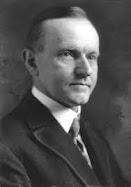
One of my New Year's resolutions in 2012 was to hit the halfway mark of At Times Dull, which, by finishing An Honest President on December 30, I accomplished. Hurray for me!
In order to do this, you may have noticed that I steamrolled through the 1870s and 80s in the month of December. As such, Cleveland was the 4th president I read about in roughly 6 weeks, and he failed to stand out.
Or rather, the things that stand out about him are the trivial things. He was the first president to use the terms "executive privilege" and "welfare state." He was the second president in a row to be the son of a preacher, and the second president in a row to be fat. He got a woman pregnant when he was a young buck, and that came back to bite him in the campaign (though obviously not that much). He stayed single until after he became president. His wife was 21, the daughter of his late business partner. His was the first wedding in the White House, and his daughter Ruth was the first birth in the White House. The candy bar Baby Ruth was named after her, not the baseball player. He was the second president in a row to have a secret medical condition - a tumor on the roof of his mouth. In the guise of a vacation cruise, his surgeon removed the tumor and part of his jaw while they were on board a yacht. And, of course, he remains the only president ever to have served two non-consecutive terms. He is both the 22nd and 24th president.
(Remember: Because of this, "How many men have been President of the United States?" is always a trick question. Although Barack Obama is the 44th president, he is only the 43rd man to be president.)
He was not a genius, but he was very confident and logical. He climbed the ranks of New York politics because of how unreserved he was in standing up to corruption. As mayor of Buffalo and then Governor of New York, he was known for vetoing anything he knew to be a result of corruption. He believed strongly in the accountability of politicians to their constituents.
In 1880, there hadn't been a Democratic president since James Buchanan, since he and his party were largely blamed for the Civil War. However, in 20 years of power, the Republicans had become more and more open about their corruption and their infighting, so a plain-speaking veto governor was just the image makeover the Democrats needed.
His first term had mostly to do with silver coinage and the tariff, which was gripping reading. He lost re-election to Benjamin Harrison for reasons which Jeffers never made totally clear. The nation was enthralled with him, especially when he married a 21-year-old and had a cute baby, but perhaps found his stubbornness uninspiring.
Harrison's one term as president, however, was a disaster. Residing over the "billion dollar Congress," Harrison and the Republicans managed to spend the gigantic surplus that presidents had been sitting on since the Civil War (wartime tariffs had not been lowered after the war was over).
So then American was like, Cleveland wasn't so bad, and elected him to the term after Harrison's. This one was more eventful, because labor exploded. Namely, the Pullman Strike happened on Cleveland's second term watch, which he shut down with federal troops because mail wasn't being delivered. So that part was pretty interesting.
Other than that, honestly, Cleveland kind of came and went for me. Tariffs, reconstruction, Indians, Central America - these are all plots that continue to move slowly forward, without any one president making a huge impact on their course. Cleveland was a refreshing guy after all the bluff and bluster of the New York Republicans, and I think that was a valuable palliative to Gilded Age politics, but he was no political marvel.
But oh, readers, At Times Dull is getting exciting. The 20th century is on the horizon, and the germs of its themes are starting to show up. Teddy Roosevelt was ubiquitous in this bio, as was Mark Twain. It's nice to be back in recognizable times.
January 15, 2013


January 01, 2013
presidential fact #23
Chet Arthur was the subject of the first birther controversy. He was born in Vermont, only miles from the Canadian border. His maternal grandparents lived in Canada, and some claimed that he was born while his mother was at their house rather than her own.
December 31, 2012
presidential fact #22
Although never a serious contender, Robert Todd Lincoln was briefly considered as Republican nominee for president in 1884.
December 28, 2012
Chet Arthur as president. Good God!

The problem with this move, politically, was that Hayes and Arthur were both Republicans. So was Conkling! The Republican party was bitterly divided into factions - the Radicals, the Stalwarts, and the moderates in between (sometimes called Mugwumps, a term which also included Democrats). Although Congress was usually split quite evenly between parties, there hadn't been a Democratic president since Buchanan. The Republicans would fight amongst themselves during a presidency, but every 4 years would have to figure out a way to back the same person for president.

But Arthur had tied his fortunes to Conkling early on. The son of a poor preacher who moved around a lot, he seemed to want the opposite — a steady job, wealth, and moral bankruptcy. He started out idealistic, but shed his idealistic friends as he got older and more ambitious.
Arthur was a young lawyer in New Yorker when governor Edwin Morgan took a shine to him and appointed him as the state's quartermaster general during the Civil War. This meant he was in charge of all the logistics for New York's troops (who numbered more than any other state's) such as housing, clothing, supplies, and food. [He may have taken this job, rather than fighting, because his wife and her family were from Virginia and sided with the South.] Either way, he was very, very good at his job. Whatever his motivations at any of his jobs, he remained an excellent administrator.
His work brought him to the attention of the party bosses, and he was ever after heavily involved in New York politics. He was especially good at coercing campaign donations out of government employees by threatening to fire them.
So he eventually runs the customs house and he's super rich and really fat and undoubtedly corrupt. He gets fired, and his friends the Stalwarts are really mad. The 1880 election is just around the corner, however, and the Radicals and Stalwarts will need to find a way to agree on a candidate. Conkling wanted Grant to run for a third term, which was bananas, the Radicals wanted Blaine. After they stalemated over that for a few days Garfield was chosen as a compromise candidate, and, as a concession to the Stalwarts, and to ensure their support, the Radicals told them they could pick the vice presidential candidate. They did not expect them to pick Chester Arthur, a man the sitting president had just fired in disgrace.
They also did not expect Garfield to die, and for Chester Arthur - a corrupt businessman who had never held elected political office - to become president. As one newspaper editor put it, while Garfield was dying: "Chet Arthur as president. Good God!"
I want to stop and point out that Arthur is one of the most fascinating men I've read about for At Times Dull. His story is so unpredictable and unlikely, and himself so enigmatic, and I was truly eager to see how it all worked out for him. I emailed Thomas C. Reeves to thank him for writing such a fascinating account, and I would recommend it. It's not only a great biography, but provides my best understanding of post-bellum politics, the civil service wars, and the national mood at this time.
So anyway, Arthur becomes president and everyone is wringing their hands. Surely he will just be a puppet for Conkling. Surely he will undo civil service reform and entrench the spoils system. Surely he will split the Republican party in two once and for all. Arthur read all of this bad press and was determined to prove it false. I wouldn't say he felt chastised by it, but perhaps abashed. He went public with the idea that he was simply there to see through the aims of the Garfield administration, of which he was now the executor. A lot of his Republican cronies, who thought they were going to cash in favors with him, eventually broke up with him because he wasn't being corrupt enough. He offered Conkling a few mid-level appointments, but certainly didn't hand him the reins of the country (thank God).
He wasn't a great or bad president. He passed civil service reform measures (the newspapers went to town with the irony of that), approved the rebuilding of the Navy, and his biggest problem, for real, was what to do with the gigantic federal budget surplus.
Also, he was recently widowed, and quite lonely. He spent a lot of money on entertaining and decorating, and hosted dinners for the bachelor Congressmen. He did his work as president dutifully, but never enjoyed it. He got a lot of flak for showing up to work late (like after lunch) and delegating too much. What his critics didn't know was that he had a SECRET FATAL DISEASE! I'm not kidding, it's just like The West Wing. Shortly after becoming president he was diagnosed with Bright's disease, a kidney condition now called nephritis. For most of his term he felt ill, had no energy, and was losing weight. He declined a run for re-election (because he knew about his secret disease) and died a year and a half after leaving office.
There were a lot of people in the country who thought Arthur had no business being president, and Arthur was first among them. Never has a forgettable presidency been such a high achievement.
December 14, 2012

December 13, 2012
presidential fact #21
With 78.4 percent of registered voters, the election of 1880 had the highest voter turnout in American history.
the later life and chronic diarrhea of James Garfield
The Civil War starts and James Garfield decides he should be a colonel (soldiers got to elect their own colonels in Ohio). What were his qualifications? A few years in the state senate and a massive ego. He was not elected to colonel because he had shown too much interest in it, which was considered ungentlemanly, and he pouted about that for a while. Then he got diarrhea.
James Garfield always had diarrhea. It was his main way of dealing with stress and emotion. His biographer notes at one point that you could tell the story of his life by how his bowels reacted to it. This is delightful to me because he had such a high opinion of himself, but he was just diarrhea all the time. He had to take breaks from being in the Civil War because of his diarrhea. He had surgery at one point during his Congressional career — all I know is that he was confined to bed for six weeks after an operation for a "painful rectal condition," but I don't know if that was the cause or the effect of the diarrhea. Either way, it was serious.
When he was done pouting and started being in the Civil War for real, he was fairly successful, but never as much as he wanted to be. He was desperate to win glory for himself. He hated it when there were long stretches between battles because how would America learn how great he was if he couldn't distinguish himself in battle? He started being like, I hate war! I want to be in the US Congress instead! But he couldn't make his mind up to leave the army because surely that pivotal battle that would make him a hero was just around the corner.
Eventually he met General William Rosecrans, who liked him immediately and offered him a job as his chief of staff. He hemmed and hawed about it because it would be more glorious to lead his own troops into battle, but eventually took the position because of the political prestige (and because having a more sedentary job would be more suited to his chronic diarrhea). It didn't quite work out that way, because Rosecrans soon became another one of the generals that Lincoln and Secretary of War Stanton could not stand. Even Garfield eventually became annoyed at Rosecrans' lack of initiative, but had to officially remain loyal to him because of his position (although that didn't stop him from writing a letter to Treasury Secretary Salmon P Chase about how annoyed he was with Rosecrans, which blew up in his face later). After a particularly disastrous display of lack of leadership at the Battle of Chickamauga, Grant was promoted above and allowed to fire Rosecrans, and Garfield basically left the army after that to run for Congress.
He was elected to Congress in 1862 and stayed there until 1879, when he was elected to the Senate for only a year before running for president. The war chapters were the last that Margaret Leech wrote before she died, and the Congress and President chapters were finished by someone else, more summarily than she would have. As a result, I know a lot less about his years in Congress than I do about his early years and war years. This may be to Garfield's disadvantage, because he was a very popular and influential member of Congress, and he and Crete were very happy once she moved to Washington with him. It could be that attaining this stature mellowed him out a bit, or that moving to Washington gave Crete a little more personality. His manic need for approval may have been salved by being a Congressman.
Even so, he was almost no one's first choice for the Republican nomination in 1880. The Republican were split between a New York-led faction that wanted Grant for a third term, and a more moderate faction that wanted James Blaine of Maine. Garfield was at the convention to support his Ohio friend John Sherman (who was Hayes' Secretary of State), but the delegates' votes were deadlocked, with neither Grant's or Blaine's supporters willing to switch over, so Garfield was proposed as a compromise candidate and quickly got the nomination. They all seem to be compromise candidates these days.
He was inaugurated in March of 1881, shot in July, and died in September. In his three "active" months in office, the only thing he accomplished was standing up to Roscoe Conkling, but it will be more interesting to talk about that in the context of Chester Arthur, who was caught in the middle of that fight, and became president upon Garfield's death.
James Garfield always had diarrhea. It was his main way of dealing with stress and emotion. His biographer notes at one point that you could tell the story of his life by how his bowels reacted to it. This is delightful to me because he had such a high opinion of himself, but he was just diarrhea all the time. He had to take breaks from being in the Civil War because of his diarrhea. He had surgery at one point during his Congressional career — all I know is that he was confined to bed for six weeks after an operation for a "painful rectal condition," but I don't know if that was the cause or the effect of the diarrhea. Either way, it was serious.
When he was done pouting and started being in the Civil War for real, he was fairly successful, but never as much as he wanted to be. He was desperate to win glory for himself. He hated it when there were long stretches between battles because how would America learn how great he was if he couldn't distinguish himself in battle? He started being like, I hate war! I want to be in the US Congress instead! But he couldn't make his mind up to leave the army because surely that pivotal battle that would make him a hero was just around the corner.
Eventually he met General William Rosecrans, who liked him immediately and offered him a job as his chief of staff. He hemmed and hawed about it because it would be more glorious to lead his own troops into battle, but eventually took the position because of the political prestige (and because having a more sedentary job would be more suited to his chronic diarrhea). It didn't quite work out that way, because Rosecrans soon became another one of the generals that Lincoln and Secretary of War Stanton could not stand. Even Garfield eventually became annoyed at Rosecrans' lack of initiative, but had to officially remain loyal to him because of his position (although that didn't stop him from writing a letter to Treasury Secretary Salmon P Chase about how annoyed he was with Rosecrans, which blew up in his face later). After a particularly disastrous display of lack of leadership at the Battle of Chickamauga, Grant was promoted above and allowed to fire Rosecrans, and Garfield basically left the army after that to run for Congress.
He was elected to Congress in 1862 and stayed there until 1879, when he was elected to the Senate for only a year before running for president. The war chapters were the last that Margaret Leech wrote before she died, and the Congress and President chapters were finished by someone else, more summarily than she would have. As a result, I know a lot less about his years in Congress than I do about his early years and war years. This may be to Garfield's disadvantage, because he was a very popular and influential member of Congress, and he and Crete were very happy once she moved to Washington with him. It could be that attaining this stature mellowed him out a bit, or that moving to Washington gave Crete a little more personality. His manic need for approval may have been salved by being a Congressman.
Even so, he was almost no one's first choice for the Republican nomination in 1880. The Republican were split between a New York-led faction that wanted Grant for a third term, and a more moderate faction that wanted James Blaine of Maine. Garfield was at the convention to support his Ohio friend John Sherman (who was Hayes' Secretary of State), but the delegates' votes were deadlocked, with neither Grant's or Blaine's supporters willing to switch over, so Garfield was proposed as a compromise candidate and quickly got the nomination. They all seem to be compromise candidates these days.
He was inaugurated in March of 1881, shot in July, and died in September. In his three "active" months in office, the only thing he accomplished was standing up to Roscoe Conkling, but it will be more interesting to talk about that in the context of Chester Arthur, who was caught in the middle of that fight, and became president upon Garfield's death.
Subscribe to:
Posts (Atom)